The platform core
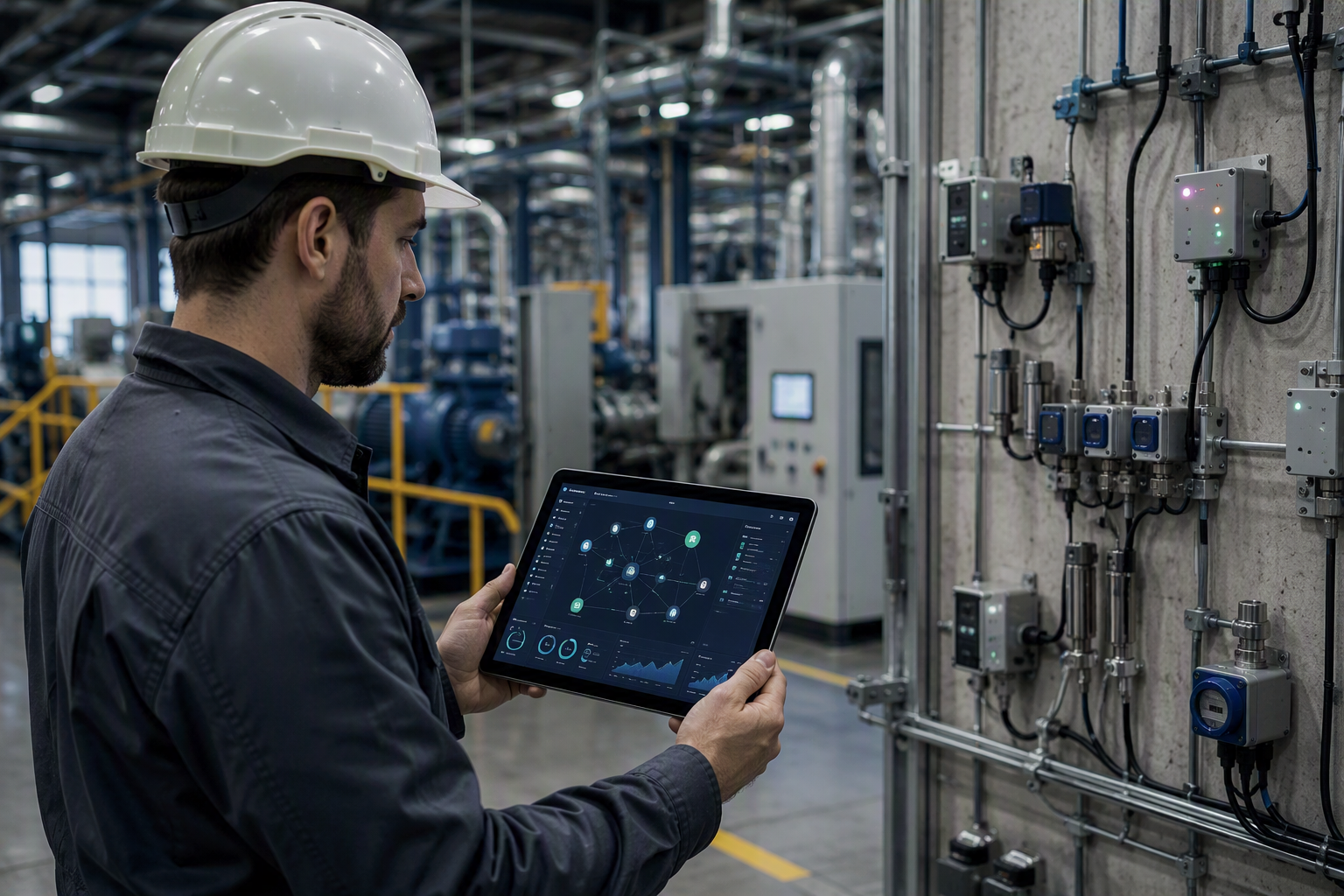
At the centre is an operating system running on industrial mini virtual machines, built in Node.js on Linux, with a family of companion applications mostly in Vue.js and React. It is the foundation everything else in the ecosystem plugs into.
A wide ecosystem of components
Within it we built an unusually broad set of components:
- Device dashboards — installing, updating and editing devices and their software.
- 3D & assembly tooling — a 3D view of device orientation from gyroscope data, and an assembly suite with visual guidance for positioning parts and following procedures.
- IoT & cloud dashboards — charting device parameters, managing containerized deployments, over-the-air firmware updates, and a real-time control panel monitoring the status of every installed device.
- Mobile & AI apps — sending and editing device parameters on mobile, and an AI-assisted web app for locating equipment.
The work even reached infrastructure and hardware — configuring web servers, domains and firewalls, routing containerized deployments, and prototyping electronics — which is unusual breadth for a single engagement and speaks to how deeply integrated the team was.
Further sub-projects
Two more strands rounded out the engagement: an IoT/web dashboard for oil production and refinery operations (sensor and measurement-instrument data, with remote configuration, diagnostics and safety systems), and a generic web interface for reading and configuring large numbers of industrial IoT devices and sensors from different manufacturers, with no fixed data structure.
Technology
Node.js, Vue.js, React.js and TypeScript with Three.js, GraphQL and Express.js; MySQL and MariaDB; Docker, NGINX and Linux; MQTT, OpenProtocol and software adapters; and embedded IoT C++ with PlatformIO and Arduino, alongside SCSS, Cypress and Material UI.